


 acelinestore1
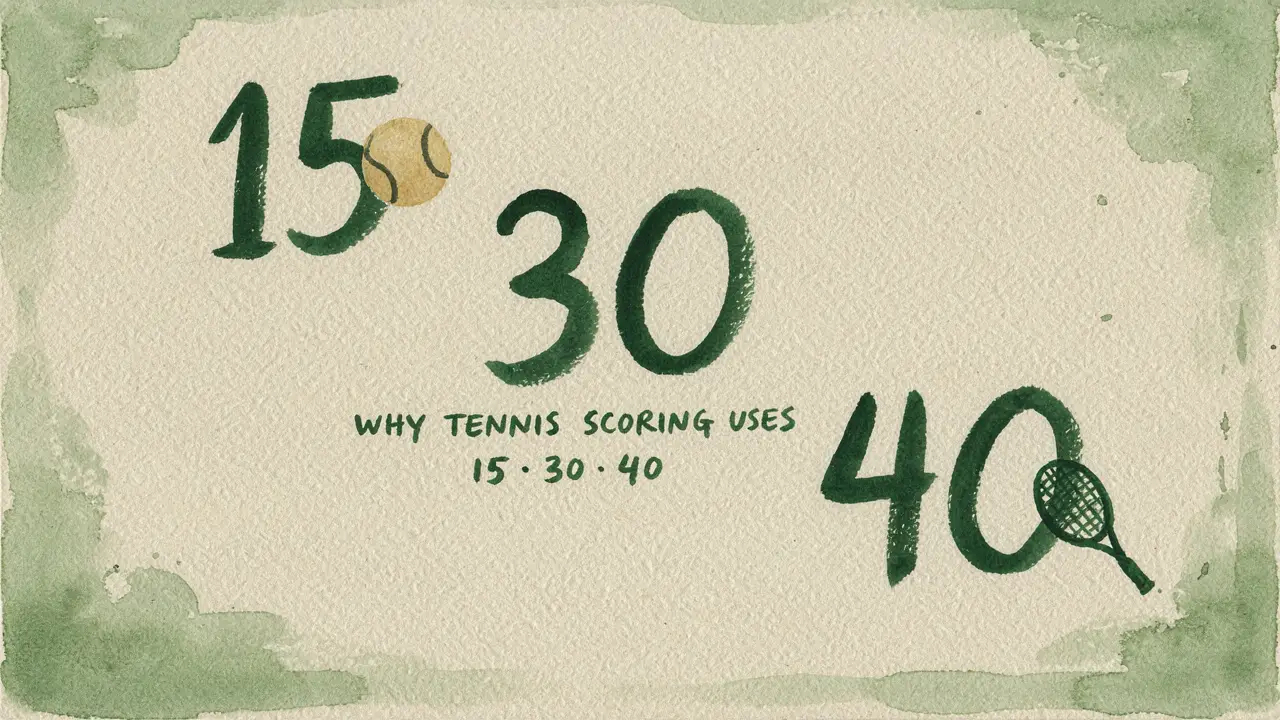
Have you ever watched a tennis match and wondered why the score goes from 15 to 30 and then 40 instead of 1, 2, and 3? The answer connects to the sport’s long history. Tennis uses the unusual 15, 30, and 40 scoring system because players inherited an old scoring tradition whose exact origin remains uncertain. One popular theory links the numbers to a clock face, while other explanations connect them to older forms of tennis played in medieval France.
Although historians still debate the original reason, the scoring system has survived for centuries. To understand why, let’s explore the history behind these numbers, the clock face theory, and the meaning of deuce and advantage.
How Does Tennis Scoring Work?
First, let’s look at how players count points during a standard tennis game.
| Points won by a player | Tennis score |
|---|---|
| Zero points | Love |
| One point | 15 |
| Two points | 30 |
| Three points | 40 |
| Four points | Game, if the player leads by two points |
A player normally needs to win at least four points to take a game. However, the player must also lead by two points.
For example, if Player A leads 40–15, winning the next point gives Player A the game. On the other hand, if both players reach 40–40, the game enters deuce.
At deuce, a player must win two consecutive points to secure the game under standard advantage scoring. This rule makes close games more competitive and adds pressure to every important point.
Why Is Tennis Scoring 15, 30, and 40?
The exact origin of tennis scoring remains a historical mystery. However, historians connect the tradition to older forms of tennis, particularly jeu de paume, a French ball game that helped shape modern tennis.
Historical references from the 15th and 16th centuries mention scores of 15, 30, and 45. These records show that the unusual scoring sequence existed long before modern lawn tennis developed.
But why did players choose these numbers instead of counting 1, 2, and 3?
Historians have proposed several explanations. The most familiar theory involves a clock face, while another connects the numbers to the court and playing traditions of medieval French tennis.
Neither explanation provides a conclusive answer. Therefore, the most accurate explanation is that modern tennis inherited a traditional scoring system, but historians cannot confirm exactly how it began.
1. The Clock Face Theory
The clock face theory offers a simple way to understand the scoring sequence.
Imagine a clock face divided into four quarters. Each quarter represents 15 minutes. According to this theory, a player advances through the following positions after winning points:
- First point: 15
- Second point: 30
- Third point: 45
- Fourth point: 60, representing the end of the game
At first glance, the explanation makes perfect sense. The numbers follow the familiar divisions of a clock, and the final position completes the circle.
However, the theory has a historical problem. Evidence does not establish that early tennis players used clock faces to keep score. Furthermore, historical references to tennis scoring predate the widespread use of minute hands on clocks.
For that reason, readers should treat the clock face explanation as a popular theory rather than a proven fact.
2. The Medieval French Tennis Theory
Another explanation connects tennis scoring to jeu de paume, which means “game of the palm” in French.
Players originally struck the ball with their hands before rackets became part of the game. Over time, this older sport influenced the development of modern tennis, including some of its terminology and traditions.
Some historical explanations suggest that the scoring numbers relate to the court’s dimensions and the way players moved forward after winning points.
Although this theory offers an interesting connection between the court and the scoring system, historians have not established it as the definitive explanation.
The important point is that tennis scoring developed from an older sporting tradition. Its unusual numbers likely reflect historical customs rather than a modern mathematical design.
Why Is It 40 Instead of 45 in Tennis?
This question naturally follows from the clock face theory. If the sequence started at 15 and continued to 30, why didn’t modern tennis keep 45?
Historical references show that earlier scoring systems used 45. Modern tennis, however, uses 40 as the third-point score.
The exact reason for this change remains uncertain. Some explanations suggest that players shortened “45” to “40” because the shorter call was easier to use during a match. Other theories connect the change to the development of deuce and advantage scoring.
Neither explanation settles the historical question.
Today, players use 40 because the sport’s rules recognize it as the third-point score. The number has become a familiar part of tennis, even though its origins remain unclear.
Why Is Zero Called Love in Tennis?
Tennis also uses the word love instead of zero. For example, when a player leads 15–love, that player has won one point while the opponent has yet to score.
The origin of this term remains debated.
One popular theory connects love to the French word l’œuf, which means “egg.” An egg resembles the shape of zero, so some people believe the word developed from that visual connection.
Another explanation links the term to older expressions about playing for nothing.
However, historians have not conclusively established either explanation. As with the numbers 15, 30, and 40, the word has survived as part of tennis tradition.
What Does Deuce Mean in Tennis?
Deuce occurs when both players reach 40–40 in a game.
Under standard advantage scoring, neither player can win the game by taking just one more point. Instead, one player must win two consecutive points.
Here is how the sequence works:
- Deuce: Both players have reached 40.
- Advantage: One player wins the next point.
- Game: The player with advantage wins the following point.
If the player with advantage loses the next point, the score returns to deuce. Both players must then compete for another two-point advantage.
For example, imagine Player A and Player B are tied at 40–40. Player A wins the next point and takes the advantage. If Player B wins the following point, the score returns to deuce.
This process can continue until one player wins two consecutive points. However, some competitions use a deciding-point format at deuce, so players should check the rules for the particular event.
Why Does Tennis Still Use This Unusual Scoring System?
Tennis could use a simple 1, 2, 3, and 4 scoring system. Nevertheless, the sport continues to follow its traditional sequence.
One reason is continuity. Players, coaches, umpires, and fans already understand the established terminology. Changing the scoring system would also require adjustments to the way people announce scores, teach the game, and follow matches.
In addition, the deuce and advantage system creates a distinct rhythm within each game. A player can reach 40 but still needs to finish the job, especially when an opponent fights back.
As a result, tennis scoring has become more than a way to count points. It is part of the sport’s identity and history.
Frequently Asked Questions About Tennis Scoring
Why is tennis scoring 15, 30, 40 instead of 1, 2, 3?
Tennis inherited its traditional scoring system from older forms of the sport. Historians have proposed several explanations for the numbers, but no single theory conclusively explains their origin.
Why does tennis use 40 instead of 45?
Earlier references include the number 45, but modern tennis uses 40. The precise reason for the change remains uncertain, although some theories suggest that players shortened the spoken score.
Is the clock face theory about tennis scoring true?
The clock face theory is popular, but historical evidence has not proved that tennis players originally used clocks to count points. It provides a memorable explanation rather than a confirmed historical answer.
How many points does a player need to win a tennis game?
Under standard advantage scoring, a player must win at least four points and lead by two. If both players reach 40, the game continues through deuce and advantage until one player wins two consecutive points.
What does love mean in tennis?
Love means zero. One theory connects the word to the French term l’œuf, meaning egg, but historians have not conclusively confirmed this origin.
What is the difference between deuce and advantage?
Deuce means both players have reached 40–40. Advantage means one player has won the next point and now needs one more point to win the game under standard advantage scoring.
Final Thoughts
The unusual 15, 30, and 40 scoring system makes tennis different from many other sports. Its history connects modern tennis to older French ball games, but the exact reason behind the numbers remains uncertain.
The clock face theory provides an easy way to remember the sequence. However, it does not offer conclusive historical proof. Other explanations connect the scoring tradition to mediaeval tennis and the customs of its players.
Ultimately, the scoring system has survived because tennis continues to follow its established rules and traditions. Once you understand the points, deuce, and advantage, you can follow even the closest games with greater confidence.