


 acelinestore1
TENNIS EXPLAINED • SCORING & LANGUAGE
It has nothing to do with romance. When an umpire calls “fifteen–love,” they are saying fifteen to nothing—through a French egg, an English ear, and about five hundred years of habit.
On grass, on clay, and on hard courts, the word is the same everywhere: love means zero.
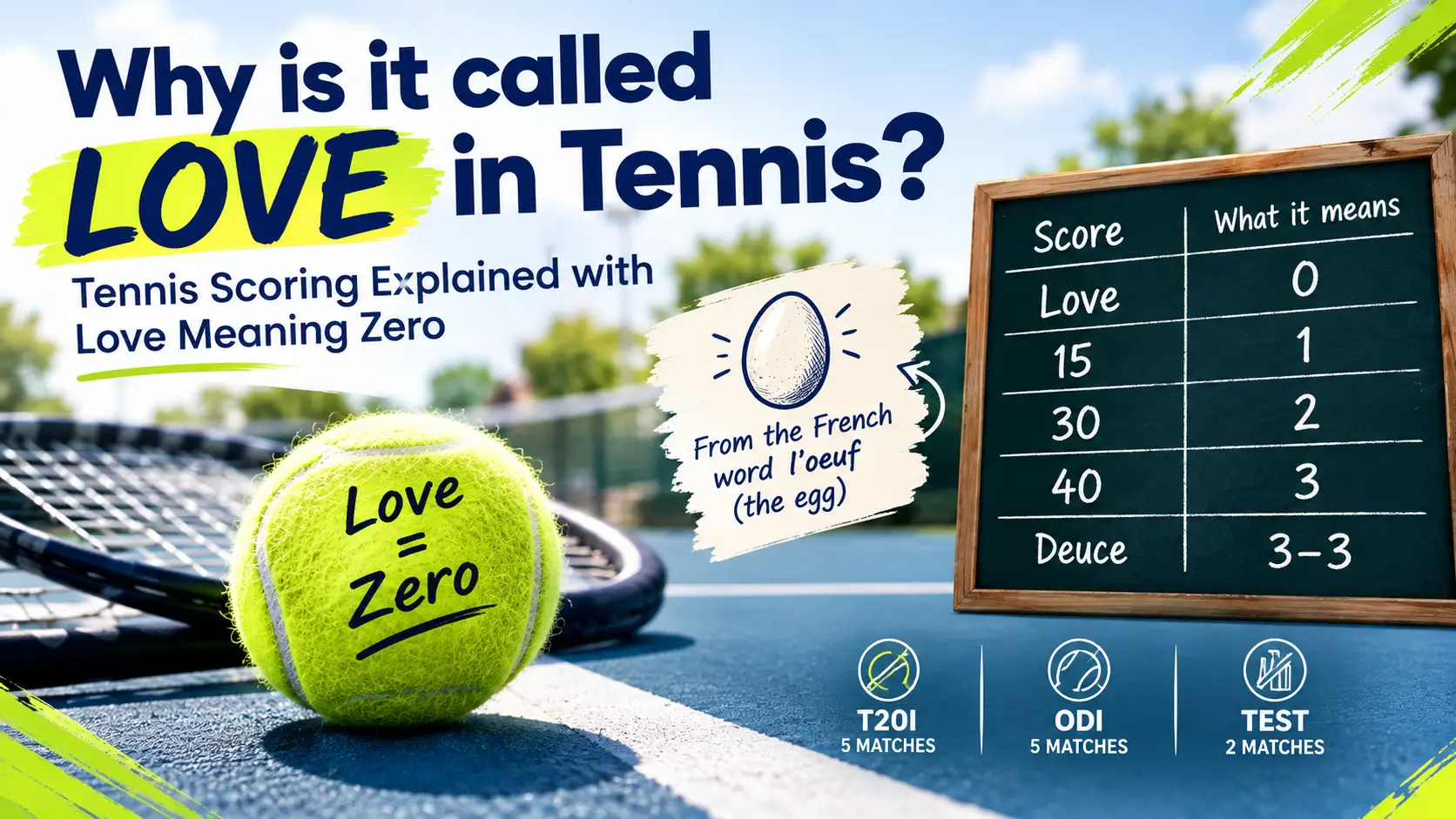
The short answer: “Love” most likely comes from the French l’oeuf—”the egg.” An egg is oval, like a 0 on the scoreboard. French players used it for zero, English listeners heard something close to “love,” and the mishearing stuck.
Tennis scoring examples
- Love-all = 0–0
- 15–love = 15–0
- 30–love = 30–0
- 40–love = 40–0
- Six–love = a 6–0 set
That is why you will hear “love” dozens of times in a single match and never hear the word “zero” from the umpire’s chair at all. Scoreboards still show 0. The spoken game kept the older, stranger word—and this document explains where it came from, what the rival explanations are, and how historians judge them.
The Leading Theory
It Started With an Egg: L’oeuf
Say the French phrase out loud, and the mystery shrinks. L’oeuf is pronounced roughly “luff”—close enough to “love” for an English ear, especially across a noisy court.
Egg, eggshell, zero: the visual joke at the heart of the theory. A scoreless player had an egg-shaped nothing.
Tennis was born in France as jeu de paume, a handball game later played with rackets in monastery courtyards and royal indoor courts. Its vocabulary was French, and its scoring was visual long before it was digital. A nought chalked on a board is an oval. Calling that oval “the egg” was a natural, slightly teasing nickname—the same instinct that later gave cricket its “duck” for zero, short for a duck’s egg.
When lawn tennis took off in England in the 1870s, players kept much of the French scoring language. Some words were translated, some kept, and some misheard into the nearest English sound. L’oeuf becoming “love” fits perfectly: the sound survived even as the meaning was lost.
Important nuance: Modern French players do not say l’oeuf or amour for zero today—they say zero (for example, quinze-zero). “Love” is an English-language fossil of a French word, preserved in English long after French tennis moved on.
Where Love Sits in the Scoring Ladder
| Points won | What the umpire calls it | Example |
|---|---|---|
| 0 | Love | Love-all (0–0 to start a game) |
| 1 | 15 | 15–love |
| 2 | 30 | 30–love |
| 3 | 40 | 40–love |
| 3–3 | Deuce | Then advantage, then game—win by two. |
The server’s score is always called first. So “love–30” means the server has won no points and the receiver has won two. In sets, a 6–0 result is read as “six–love.”
Rival Theories & History
Three Other Stories—and Why Historians Rank Them Lower
No surviving document proves the egg theory beyond doubt, which is why three alternatives keep circulating. Each captures something true about old tennis, even if it is probably not the origin of the word.
1. Playing “For Love”
To play “for love” meant to play for nothing—no stakes, no wager, no prize. A player on zero was therefore playing for love. It is elegant and very English, but it explains the idea of nothing better than it explains the word itself.
2. Dutch “Lof”—for Honour
The Dutch expression “iets voor lof doen” means to do something for praise or honor, again with nothing material at stake. The sound is close, and the sense fits, but there is little evidence of a Dutch route into French-born tennis.
3. Love for Each Other at 0–0
The most romantic version: at Love All, before a point is won, the players still have love for each other. It makes a lovely commentary line, but historians treat it as a later folk explanation, not a documented origin.
So Which Is True?
Most reference works back the egg theory because it explains both the sound and the shape and parallels cricket’s duck’s egg. The honest verdict is: l’oeuf is the leading theory, not a proven fact—and that uncertainty is part of why the story endures.
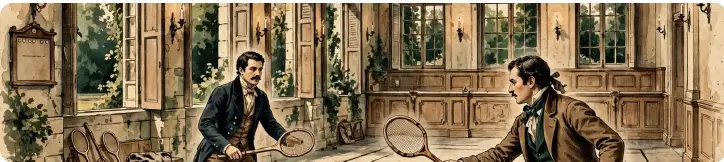
Jeu de paume in France: the indoor ancestor of modern tennis, where the game’s French vocabulary was formed.
How the Word Travelled
12th–16th century—Jeu de paume in France
Tennis develops as a French court game; its language and customs form in French.
1870s — Lawn tennis in England
The outdoor game is codified in Britain and spreads rapidly, carrying French-derived terms with it.
Today—kept by the rules and the umpire’s call.
Scoreboards display 0, but officials still call “love”—tradition preserved in speech.
Using It & Enjoying It
Love’s Cousins, and How to Hear a Score Like a Regular
Once love clicks, a whole shelf of tennis slang falls into place—because tennis never stopped naming zeroes after food.
Bagel: In modern slang, winning a set 6–0 is a “bagel”—the zero is the bagel’s round shape with a hole. A 6–0, 6–0 win is a “double bagel.” It is the direct descendant of the egg idea: round food for a round zero.
Duck (cricket): A batter dismissed for zero is out for a “duck,” originally a “duck’s egg.” Two different sports, two different countries, the same visual joke—strong circumstantial support for the egg family of explanations.
Deuce: At 40–40, the call is “deuce,” usually linked to French a deux de jeu—two points from the game—or to Old French deus, two. Like love, it is French vocabulary that English tennis kept and reshaped.
A 30-Second Guide to Any Score Call
- Listen for the server first. “30–love” always means server 30, receiver 0.
- “All” means tied. “15-all,” ” 30-all “—and at the very start, “love-all.”
- Love only lives inside games and sets. You will not hear it for tiebreak points, which are counted plainly: 1, 2, 3.
- A love game is a perfect game. Winning a game to love means your opponent won no points in it.
- A love set is 6–0. Dominant, memorable, and the source of the bagel joke above.
Next time you hear “forty–love,” hear it for what it is: not a declaration of affection, but a centuries-old egg, misheard in England and lovingly preserved by every umpire since.
Sources and Further Reading
- Wikipedia—Tennis scoring system (origins of “love”: playing for love, l’oeuf, Dutch lof, and love for each other).
https://en.wikipedia.org/wiki/Tennis_scoring_system - Coffee Break Languages—Jeu, Set, Match! Essential tennis terms (l’oeuf and deuce).
https://coffeebreaklanguages.com/2019/06/jeu-set-match-parlez-vous-tennis/
Illustrations in this document are original editorial artwork created for this explainer, not photographs of specific matches or players.
Note on certainty: The origins of sporting terms from this period were rarely written down at the time. This document presents l’oeuf as the most widely accepted theory, as reference works do, while showing the main alternatives rather than presenting any one story as proven fact.
TENNIS EXPLAINED • SCORING & LANGUAGE
It has nothing to do with romance. When an umpire calls “fifteen–love,” they are saying fifteen to nothing—through a French egg, an English ear, and about five hundred years of habit.
On grass, on clay, and on hard courts, the word is the same everywhere: love means zero.
The short answer: “Love” most likely comes from the French l’oeuf—”the egg.” An egg is oval, like a 0 on the scoreboard. French players used it for zero, English listeners heard something close to “love,” and the mishearing stuck.
Tennis scoring examples
- Love-all = 0–0
- 15–love = 15–0
- 30–love = 30–0
- 40–love = 40–0
- Six–love = a 6–0 set
That is why you will hear “love” dozens of times in a single match and never hear the word “zero” from the umpire’s chair at all. Scoreboards still show 0. The spoken game kept the older, stranger word—and this document explains where it came from, what the rival explanations are, and how historians judge them.
The Leading Theory
It Started With an Egg: L’oeuf
Say the French phrase out loud, and the mystery shrinks. L’oeuf is pronounced roughly “lff”—close enough to “love” for an English ear, especially across a noisy court.
Egg, eggshell, zero: the visual joke at the heart of the theory. A scoreless player had an egg-shaped nothing.
Tennis was born in France as jeu de paume, a handball game later played with rackets in monastery courtyards and royal indoor courts. Its vocabulary was French, and its scoring was visual long before it was digital. A nought chalked on a board is an oval. Calling that oval “the egg” was a natural, slightly teasing nickname—the same instinct that later gave cricket its “duck” for zero, short for a duck’s egg.
When lawn tennis took off in England in the 1870s, players kept much of the French scoring language. Some words were translated, some kept, and some misheard into the nearest English sound. L’oeuf becoming “love” fits perfectly: the sound survived even as the meaning was lost.
Important nuance: Modern French players do not say l’oeuf or amour for zero today—they say zero (for example, quinze-zero). “Love” is an English-language fossil of a French word, preserved in English long after French tennis moved on.
Where Love Sits in the Scoring Ladder
| Points won | What the umpire calls it | Example |
|---|---|---|
| 0 | Love | Love-all (0–0 to start a game) |
| 1 | 15 | 15–love |
| 2 | 30 | 30–love |
| 3 | 40 | 40–love |
| 3–3 | Deuce | Then advantage, then game—win by two. |
The server’s score is always called first. So “love–30” means the server has won no points and the receiver has won two. In sets, a 6–0 result is read as “six–love.”
Rival Theories & History
Three Other Stories—and Why Historians Rank Them Lower
No surviving document proves the egg theory beyond doubt, which is why three alternatives keep circulating. Each captures something true about old tennis, even if it is probably not the origin of the word.
1. Playing “For Love”
To play “for love” meant to play for nothing—no stakes, no wager, no prize. A player on zero was therefore playing for love. It is elegant and very English, but it explains the idea of nothing better than it explains the word itself.
2. Dutch “Lof” — for Honour
The Dutch expression iets voor lof doen means to do something for praise or honour, again with nothing material at stake. The sound is close, and the sense fits, but there is little evidence of a Dutch route into French-born tennis.
3. Love for Each Other at 0–0
The most romantic version: at love-all, before a point is won, the players still have love for each other. It makes a lovely commentary line, but historians treat it as a later folk explanation, not a documented origin.
So Which Is True?
Most reference works back the egg theory because it explains both the sound and the shape, and parallels cricket’s duck’s egg. The honest verdict is: l’oeuf is the leading theory, not a proven fact — and that uncertainty is part of why the story endures.
Jeu de paume in France: the indoor ancestor of modern tennis, where the game’s French vocabulary was formed.
How the Word Travelled
12th–16th century — Jeu de paume in France
Tennis develops as a French court game; its language and customs form in French.
1870s — Lawn tennis in England
The outdoor game is codified in Britain and spreads rapidly, carrying French-derived terms with it.
Today — Kept by the rules and the umpire’s call.
Scoreboards display 0, but officials still call “love” — tradition preserved in speech.
Using It & Enjoying It
Love’s Cousins, and How to Hear a Score Like a Regular
Once love clicks, a whole shelf of tennis slang falls into place — because tennis never stopped naming zeroes after food.
Bagel: In modern slang, winning a set 6–0 is a “bagel” — the zero is the bagel’s round shape with a hole. A 6–0, 6–0 win is a “double bagel.” It is the direct descendant of the egg idea: round food for a round zero.
Duck (cricket): A batter dismissed for zero is out for a “duck,” originally a “duck’s egg.” Two different sports, two different countries, the same visual joke — strong circumstantial support for the egg family of explanations.
Deuce: At 40–40, the call is “deuce,” usually linked to French a deux de jeu — two points from the game — or to Old French deus, two. Like love, it is French vocabulary that English tennis kept and reshaped.
A 30-Second Guide to Any Score Call
- Listen for the server first. “30–love” always means server 30, receiver 0.
- “All” means tied. “15-all,” “30-all” — and at the very start, “love-all.”
- Love only lives inside games and sets. You will not hear it for tiebreak points, which are counted plainly: 1, 2, 3.
- A love game is a perfect game. Winning a game to love means your opponent won no points in it.
- A love set is 6–0. Dominant, memorable, and the source of the bagel joke above.
Next time you hear “forty–love,” hear it for what it is: not a declaration of affection, but a centuries-old egg, misheard in England and lovingly preserved by every umpire since.
Sources and Further Reading
- Wikipedia — Tennis scoring system (origins of “love”: playing for love, l’oeuf, Dutch lof, and love for each other).
https://en.wikipedia.org/wiki/Tennis_scoring_system - Coffee Break Languages — Jeu, Set, Match! Essential tennis terms (l’oeuf and deuce).
https://coffeebreaklanguages.com/2019/06/jeu-set-match-parlez-vous-tennis/
Illustrations in this document are original editorial artwork created for this explainer, not photographs of specific matches or players.
Note on certainty: The origins of sporting terms from this period were rarely written down at the time. This document presents l’oeuf as the most widely accepted theory, as reference works do, while showing the main alternatives rather than presenting any one story as proven fact.